Thanks for your patience during our recent outage at scalar.usc.edu. While Scalar content is loading normally now, saving is still slow, and Scalar's 'additional metadata' features have been disabled, which may interfere with features like timelines and maps that depend on metadata. This also means that saving a page or media item will remove its additional metadata. If this occurs, you can use the 'All versions' link at the bottom of the page to restore the earlier version. We are continuing to troubleshoot, and will provide further updates as needed. Note that this only affects Scalar projects at scalar.usc.edu, and not those hosted elsewhere.
Early Indigenous LiteraturesMain MenuThe Child Who Would be Sovereign: Settler Colonial Frustrations and the Figure of the Child in Gertrude Simmons Bonnin's American Indian StoriesBy: Kai ChaseIllicit Relations: The Challenges and Possibilities of Black and Indigenous Relationssoumya rachel shailendraLegibility and Ambivalence in 19th Century Indigenous Women's WritingAn exhibit on E. Pauline Johnson and Sarah Winnemucca by Emma CohenLyric Histories: An Investigation of Early Black (and) Native America through Poetic Vignettesby Kira TuckerMarriage and Empire in 19th Century Native American Women's Literatureby Angad SinghNot-not blood quantum: the Dawes Act and ambivalent Indigeneityby Yasmin YoonReading Indigenous Authorial Presence in 18th- and 19th-century ParatextsTitle Page for Isabel Griffith-Gorgati's ExhibitResistance on and off the Page: A Collaborative Conversation between Black and Indigenous Literary ContributorsFeaturing James Printer, Katherine Garret, Phillis Wheatley, and John Marrant (17th-18th Century Early Print Culture Participants)- By Lauren JohnsonSpiritual Armies, Resurrected Bones, and “Boundless” Continents: How Indigenous Activists in Early New England Reconfigured Puritan Millennialist NarrativesFeaturing texts of Samson Occom, William Apess, and the Wampanoag Bible. By Surya MilnerSovereignty or Removal: The Conflicting Indigenous Policies of 1835 in the Continental United StatesJulia GilmanWhat Does Water Do For Indigenous Peoples of the Great Lakes Region?Featuring Heid E. Erdrich, Simon Pokagon, Black Hawk, and Simon Kofe by Sarah Nisenson(Re)introducing Black Hawk and The Life (1833)BHR 1-IntroYasmin Yoonf7f231e474bf43796f973cd0ee560919050f7427Lydia Abedeen321b94302eca10e499769fd0179e64cd33bc4cd5Kira Tuckeracf97d948460e98cd439646cc2db7ae17c5ebd9dsarah nisenson7cb5d2c1682fbd145e76716f3924f03bf25c616aKai Chased7cab5968a3a916efd1a14a48cc4832d5d5514aeSoumya Shailendra86c246fcc4aea83787381bffd2b839885bef5096Bennett Herson-Roeserc8289125445a56c819045a0091daf0402b3e0875Surya Milner077f837f3d662fd5ef9055f8258e5c47bb11f714Julia Gilmanb860a8277eea484f91a1a9e0423cab4b52bae522Lauren Johnson98dac03e7c9c1ad41e1c0a8583704e55802f98baAngad Singhd2b8d1d68ec374981c9e99b7cb400803bc678231Emma Cohen146e757b9fc3b3b416edecbf79592e8d743d4ba1Charlotte Goddu2d4c020870148128c7824ece179e04cffe180d95Isabel Griffith-Gorgati985a05928a67a856791fffac3dbba8acc85f6f37
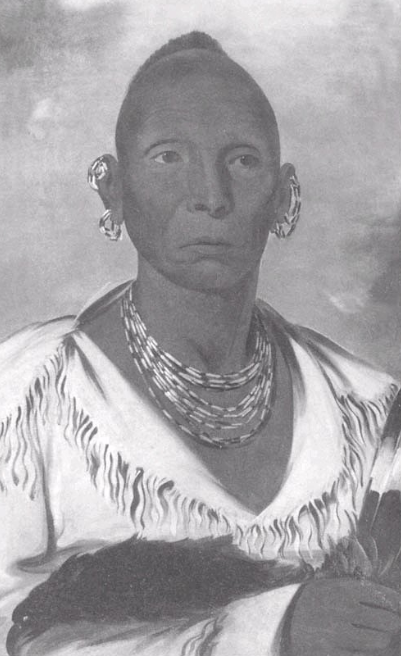
Black Hawk, 1832. Portrait by George Catlin
1media/Black Hawk, 1832, portrait by george Catlin--smithsonian--from nichols, ed_thumb.png2022-12-18T20:11:16-08:00Bennett Herson-Roeserc8289125445a56c819045a0091daf0402b3e0875416961BHR-Intro-Imageplain2022-12-18T20:11:17-08:00Bennett Herson-Roeserc8289125445a56c819045a0091daf0402b3e0875
Chief Black Hawk’s primary text Life of Ma-ka-tai-me-she-kia-kiak, or Black Hawk defies easy genre classification. It shifts between subjects as part personal narrative of a chief determinedly defending his people and their homelands; part cultural history of his fellow Sac people and their relationship with the natural landscape, other Indigenous nations, and Anglo colonial powers; and part searing critique of U.S. Indian policy, settler morality, and settler epistemology. It blends a tone of melancholy for the collective losses of his people with an attitude of radical hope, “survivance,” “continuance,” and (re)assertion of Sac lifeways.[1] The multiple grounds—literal and metaphorical—covered in the text are complicated further by the multiple voices within the text: Black Hawk’s words have never been permitted to stand on their own. Throughout numerous editions, from original publication (1833) to the most recent edition (2021),[2] Black Hawk’s text has been translated, edited, and introduced by interlocuters who have tended to overwrite his nuanced text with their own “settlerscapes”[3]—overwritten in that they romanticize, disavow, or erase the very settler colonial violence that Black Hawk’s text inveighs and actively resists. Participating in a settler colonial reiteration of rhetorical and spatialized violence, Black Hawk’s unseeing interlocuters have participated in a vicious continuity of the violence of the early nineteenth century that bleeds into our contemporary moment.[4]Black Hawk and his text need a reintroduction to American readers.
[1] For melancholy and parallels with the genre of elegy, see Arnold Krupat, “That the People Might Live:” Loss and Renewal in Native American Elegy (Ithaca, N.Y., 2012); for survivance and continuance, see Gerald Vizenor, ed., Survivance: Narratives of Native Presence (Lincoln, Neb., 2008), esp. chap. 1.
[2] Following the original publication are numerous renditions: Richard James Kennett’s edition (1836), Patterson’s revised edition (1882), James D. Rishell’s edition (1912) Milo Milton Quaife’s edition (1916), Roger L. Nichols edition (1999), J. Gerald Kennedy’s edition (2008), and most recently Michael A. Lofaro’s edition (2021).
[3] For “settlerscapes,” see Ezra D. Miller, “‘But It Is Nothing Except Woods’: Anabaptists, Ambitions, and a Northern Indiana Settlerscape, 1830-1841,” in Ryan D. Harker and Janeen Bertische Johnson, eds., Rooted and Grounded: Essays on Land and Christian Discipleship (New York, 2016).
[4] As scholar Patrick Wolfe argues: settler colonialism “is a structure, not an event.” Wolfe, “Settler Colonialism and the Elimination of the Native,” Journal of Genocide Research, 8, no. 4 (December 2006): 387-409, quotation at 388. See also, J. Kēhaulani Kauanui, “‘A Structure, Not an Event’: Settler Colonialism and Enduring Indigeneity,” Lateral 5, no. 1 (Spring 2016): n.p. For “vicious,” I follow Kyle Whyte’s terminology of “vicious sedimentation” and “insidious loops,” see Whyte, “Settler Colonialism, Ecology, and Environmental Injustice,” Environment and Society 9 (2018): 125-144.