Thanks for your patience during our recent outage at scalar.usc.edu. While Scalar content is loading normally now, saving is still slow, and Scalar's 'additional metadata' features have been disabled, which may interfere with features like timelines and maps that depend on metadata. This also means that saving a page or media item will remove its additional metadata. If this occurs, you can use the 'All versions' link at the bottom of the page to restore the earlier version. We are continuing to troubleshoot, and will provide further updates as needed. Note that this only affects Scalar projects at scalar.usc.edu, and not those hosted elsewhere.
Art in an Early Global World at WAM: A WAM/College of the Holy Cross CollaborationMain MenuAmanda Luyster17d39c1ecea88fb7ff282fe74a410b89478b8327Created by the Worcester Art Museum and the College of the Holy Cross, with the Worcester Public Schools AP Art History class of 2024. Financial support provided by the Medieval Academy of America and "Scholarship in Action" at Holy Cross.
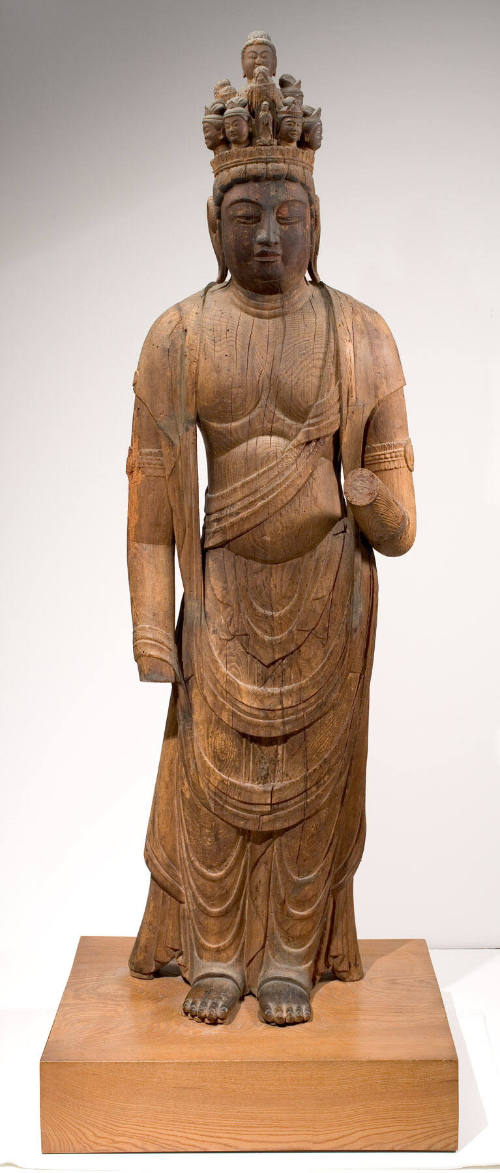
Devotion to the Bodhisattva of Compassion with eleven heads was especially popular among Japanese Buddhists of the 9th and early 10th century CE. Atop the deity’s head perch eleven miniature heads. Look closely to see that three heads show bodhisattvas (enlightened beings), three heads have tusks, three heads display righteous anger, and a single head at the back is laughing. A Buddha head sits at the pinnacle and a small, standing image of Amida Buddha attaches to the center of the main head’s crown. Inside the hollowed-out, wooden sculpture, documents and treasures were found, offering insight into its creation and its role in miracles attributed to the bodhisattva. Kannon is a bodhisattva associated with protection who is capable of manifesting in thirty-five forms to aid humanity.
Edited by Erica Belden, College of the Holy Cross, Class of 2026