Thanks for your patience during our recent outage at scalar.usc.edu. While Scalar content is loading normally now, saving is still slow, and Scalar's 'additional metadata' features have been disabled, which may interfere with features like timelines and maps that depend on metadata. This also means that saving a page or media item will remove its additional metadata. If this occurs, you can use the 'All versions' link at the bottom of the page to restore the earlier version. We are continuing to troubleshoot, and will provide further updates as needed. Note that this only affects Scalar projects at scalar.usc.edu, and not those hosted elsewhere.
12016-04-28T11:02:01-07:00Nicole Willoughby98744ed2f3ce741a3f7d00bba65ddf1e7d0a640794117plain2016-05-19T21:58:06-07:00Jamie McDaniel7d1c50d66443d970871743d62f90c2a04a2f2c84 In the early 20th century, education wasn’t the number one priority; the number one priority was survival. Miners flooded to Cherokee and Crawford County Kansas in search of work from all over the world. The goal was to provide a living for their family. With more than 300 known mines between the two counties, mining communities began popping up so that miners or the mining companies could build houses for the miners and families to live.
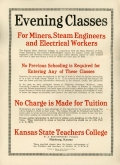
During the early days of mining, the diseases that began to spring up were not know. With research, by the end of the mining boom, preventions were made for preventing diseases such as coal-miner’s black lung. Pittsburg State University, formerly Kansas State Teachers College began offering courses to the miners in the field that they were currently working in, no prior school necessary. The problem presented to the miners for furthering their education was distance. Not all mining communities were located in close proximity to Pittsburg, Kansas. While the intent was to further educate the miners of the communities, the distance caused a challenge in further education.
In the map below are listed 24 of the over 300 mining communities that popped up between Cherokee and Crawford County. The closest was five miles away while the furthest away was around twenty miles. These statistics are based off of google maps and 2016 driving standards. Road driving conditions have improved greatly from the early twentieth century to the early twenty first century. Another consideration is the cost of living versus the luxury of owning your own vehicle. This being said, the option for miners to drive to Kansas State Teacher’s College in the early 1900’s wasn’t a feasible possibility for most mine workers.
This page has paths:
12016-04-27T12:45:07-07:00Nicole Willoughby98744ed2f3ce741a3f7d00bba65ddf1e7d0a6407Working-Class Rhetoric versus Professional RhetoricJamie McDaniel8plain2821032016-05-19T22:35:29-07:00Jamie McDaniel7d1c50d66443d970871743d62f90c2a04a2f2c84
This page references:
12016-04-28T11:19:32-07:00Kansas State Teacher's College1Education Fliermedia/MH8_nd_p017.jpgplain2016-04-28T11:19:32-07:00