Richard III: "Looking for Richard," Redux
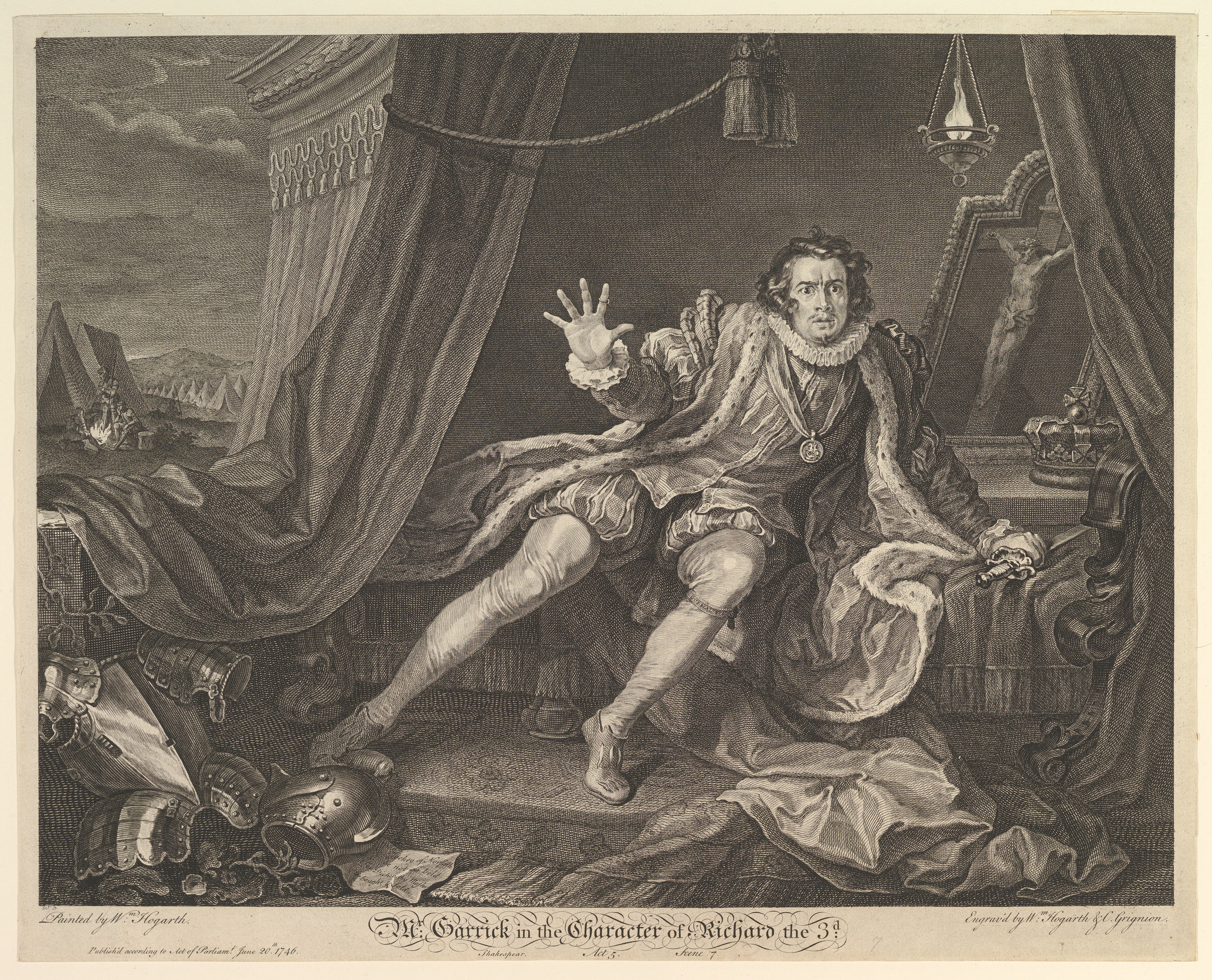
--Open with many "faces" of RIII: not only that which came to view recently, but as materially present on stage and screen throughout time (links to images here, with framing text about the range and texts upon which it draws)
- The University of Leicester's facial and vocal reconstruction
--Chief among these Shakespeare's rendering, with famous passages/links to videos
- A horse, a horse!
- Opening Speech
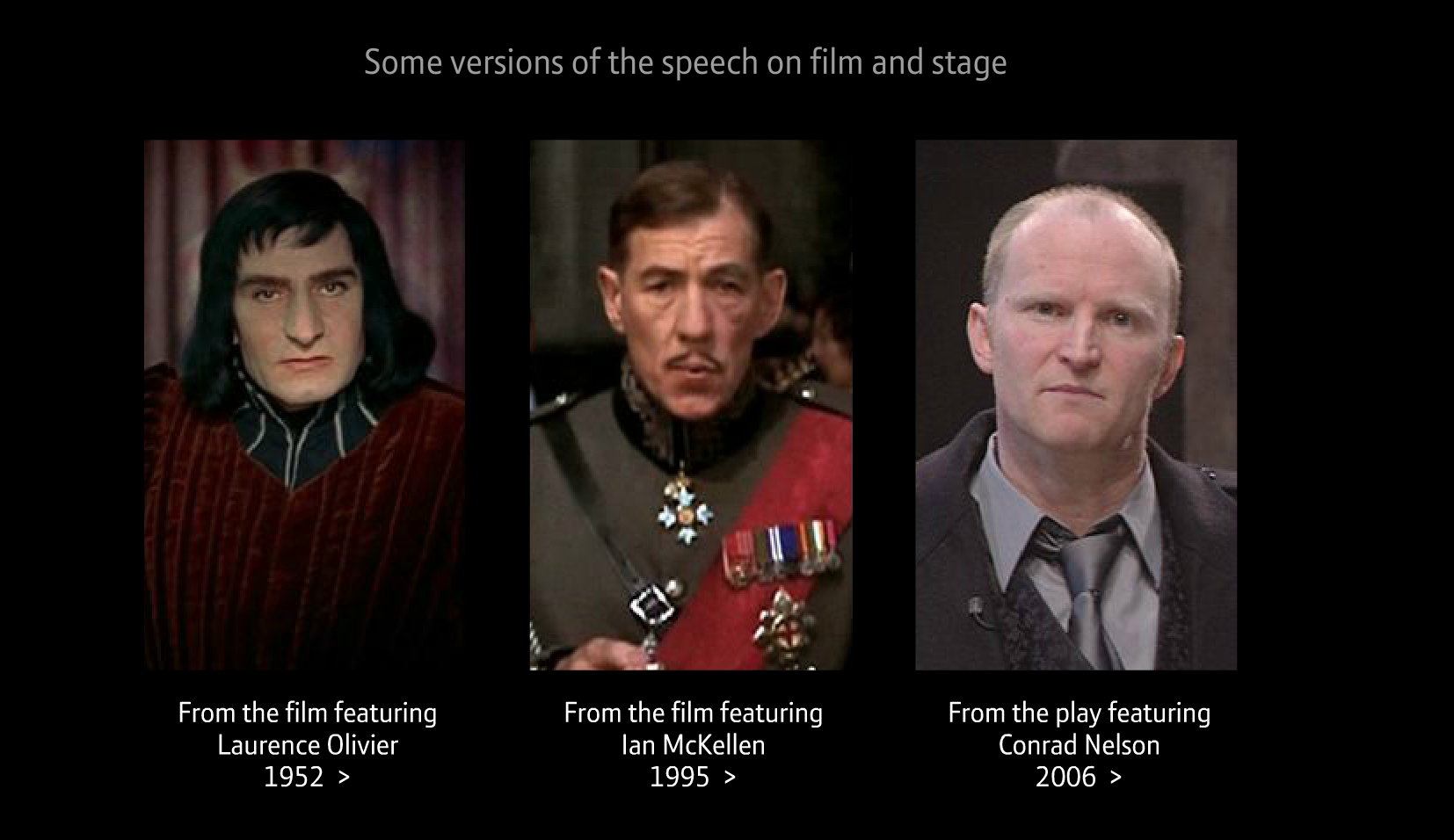
As Al Pacino's 1996 Looking for Richard suggests, these moments are ones through which the play has entered popular consciousness. Yet appreciating its presentation of the king as a portrayal involves both engaging the work as a whole and delving into its textual and contextual history. Below are resources to aid your work to this end.
The play's thematic interests include:
Villainy
The play begins with Richard's monologue in which he announces his determination "to prove a villain" (1.1.30). Much of the play revolves around his malevolent plans, and he associates himself with a certain kind of villain, the Vice figure from late medieval drama (3.1.82). The Vice was known for playing tricks on other characters and appealing to audiences through monologues and asides that tried to make members of the audience feel complicit in his villainies. Note how Richard carries out his plans and how his methods change throughout the play. What do other characters think about Richard, and how do they express those thoughts?
Prophesies, Curses & Dreams
Margaret's curses seem to do more than simply foreshadow what happens later in the play. Richard's initial monologue mentions "Plots have I laid, inductions dangerous, / By drunken prophecies, libels and dreams" (1.1.32-3). Yet in a play with many prophecies and dreams, how much control does Richard appear to have over them? How do dreams work in this play? Consider Clarence's lengthy account of his dream (1.4.9-63); Lord Stanley's dream, as described by the messenger in Act 3, Scene 2; and Richard's dream before the battle at Bosworth (starting at 5.3.177). Also, pay attention to curses, especially from Margaret and other women in the play. How accurate do the curses seem, and what kind of power might they have? Why do most of the curses come from women?
[[Include potential visualization here bringing forward clusters that surround the word "dream": Voyant, perhaps AntConc, and potentially VEP work to place these patterns in context.]]
Persuasion
Shakespeare's presentation of Richard's tale casts its central figure as anything but conventionally attractive. (quote lines here) Yet repeatedly, characters initially opposed to Richard find themselves converted to his views. (Anne, Margaret, etc.). Look briefly at the first of these speeches, then the second. How would you describe the rhetorical technique Richard repeatedly uses?
The ancient Greek term for Richard's approach is stichomythia. To see this rhetorical technique in action, click here. [[VEP visualization here with "rules" designed to highlight repeated and related words in these passages.]]
Throughout the play, what, if any, other approaches to persuasion does Richard take? (One further scene: the paralleled "Hollow Crown" rallying of the troops.) Why might Richard's varied approaches prove more or less successful at particular points?
Conscience
Richard III is arguably a play about conscience. Note the dialogue between the two murderers in the Tower of London (starting at 1.4.100). One says that his conscience is within Richard's purse with their reward for the murder. Richard mentions his "coward conscience" before the battle at Bosworth (5.3.179); later in the same scene, he claims that "Conscience is but a word that cowards use" (5.3.309). Where else can you find "conscience" in the play? What tool could you use for this kind of search? What do these lines suggest about how conscience was understood in the period? What if we consider Richard's statements regarding conscience next to Hamlet's similar statement in his "To be or not to be" speech: "Thus conscience does make cowards of us all"?
Activity 1. Check your copy of Richard III to see if it is based on the quarto or folio version of the play. Then go to the library or look online for an edition of the play based on the version that your edition is not based on. The goal is to place a quarto version and a folio version side-by-side. Turn to Act 1, Scene 4, and look at the above mentioned discussion of conscience between the two murderers (or "executioners" as they are called in the quarto). Notice that the quarto and folio assign lines differently so that some lines spoken by murderer/executioner 1 in the quarto are assigned to murderer/executioner 2 in the folio, and vice-versa. Continue comparing both version through the end of the scene. What differences do you notice? What are some implications, not just for the two characters, but for the scene and perhaps the entire play more generally? Write a brief (1-2 paragraph) analytical argument based on your observations and interpretations, and be prepared to discuss these arguments in class.
Activity 2. [PERHAPS SOMETHING WITH ANTCONC: one approach would be to use KWIC clusters in either AntConc or Voyant.]
Disability
[[This British Library resource might also be a useful reference for students' further reading.]]
Ghosts
[[This might be beyond our reach for now, but I'd love to use the language of the near-final accusatory scene as a lens for looking back on ways each character involved has spoken throughout the play. With the right rules, VEP might be useful.]]
--Yet as brought forward through Richard's ongoing memorial in the English East Midlands town of Leicester (site of...), the images we know of Richard were themselves refracted through a particular political lens--here, one concerned to legitimize and glorify the Lancastrian line of Henry Tudor (Henry VII) and his successors. (links to Leicester resources raising questions about R3's complexity)
****
(part 2 pending)
Sources, Influences, Resonances
* Book History
* Corpus Approaches
--In what ways might patterns in the extant textual record place what we see as Richard's characteristic features in context? (Note: searches of this kind could go several ways: am working out which seem most useful/interesting/productive of further questions.)
(discovery exercise using CQPWeb and Early Print to explore rhetorical patterns we associate with Shx's Richard, but which have wider-ranging foundations in the preserved textual record)