Thanks for your patience during our recent outage at scalar.usc.edu. While Scalar content is loading normally now, saving is still slow, and Scalar's 'additional metadata' features have been disabled, which may interfere with features like timelines and maps that depend on metadata. This also means that saving a page or media item will remove its additional metadata. If this occurs, you can use the 'All versions' link at the bottom of the page to restore the earlier version. We are continuing to troubleshoot, and will provide further updates as needed. Note that this only affects Scalar projects at scalar.usc.edu, and not those hosted elsewhere.
Curating in the Continuous Present: A Rehearsal For Gertrude Stein's Objects Lie on a TableMain MenuA Detective Story“Objects on a table and the explanation.” (Stein, Objects, 105)The tableau has come off the wall.How to Write (in and of time)“In doing this thing, I hope to find out this question.” (Stein, How Writing is Written, 156)“Act so there is no use in a center.” (Stein, Tender Buttons, 63)“What is a relation?” (Stein, Objects, 105)“It is by no means strange to arrange.” (Stein, Stanzas in Meditation, 143)Re-Arranging Rhetoric“With which part of the arrangement are they in agreement.” (Stein, How to Write 136)What might the rehearsal of this play mean for exhibition making?path 2A Dramaturgy for Curating Processpath 2Rehearsals for Curating Reversalspath 2And afterwards. Now that is all. (Stein, Composition, 6)essay conclusionWorks Citedbibliographic informationEmelie Chhangur2d057680e6c2808d559b662d85db94eee62664f7
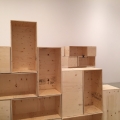
Custom-made 10’ diameter rotating platform, 2014, and 25 boxes, 2016
12016-02-23T19:55:47-08:00Emelie Chhangur2d057680e6c2808d559b662d85db94eee62664f783113plain2016-02-27T08:09:38-08:00Emelie Chhangur2d057680e6c2808d559b662d85db94eee62664f7Custom-made 10’ diameter rotating platform, 2014, and 25 boxes, 2016. Wood. Designed by Emelie Chhangur, Michael Maranda, and Suzanne Carte and fabricated by Brian Davis and Carmen Schroeder. Courtesy of the Art Gallery of York University, Toronto.
“What is the difference between houses and a table. What is the difference between objects on a table and furniture in houses. Had you ever thought of that. Objects on a table make a standpoint of recompense and result, furniture in houses do decide matters.” (Objects 108) These “tables” are custom designed to do other things other than simply table. They are objects that act as tables, sometimes. When they are boxes, they contain, rather than display, for instance. Boxes stacked become shelves, alone they become seats, or, when arranged together on the floor, they become platforms to stand on—like a stage. They also act as plinths, assuming the role of gallery furniture (rather than the role of apple boxes for theatre). The oversized, 10’ diameter “lazy susan” turns. What is usually found holding spices in the cupboards of kitchens is now on the floor “housing” objects or hosting roundtable discussions. Tables play an active role in this composition. The alter has been altered. The tableau has come off the wall.