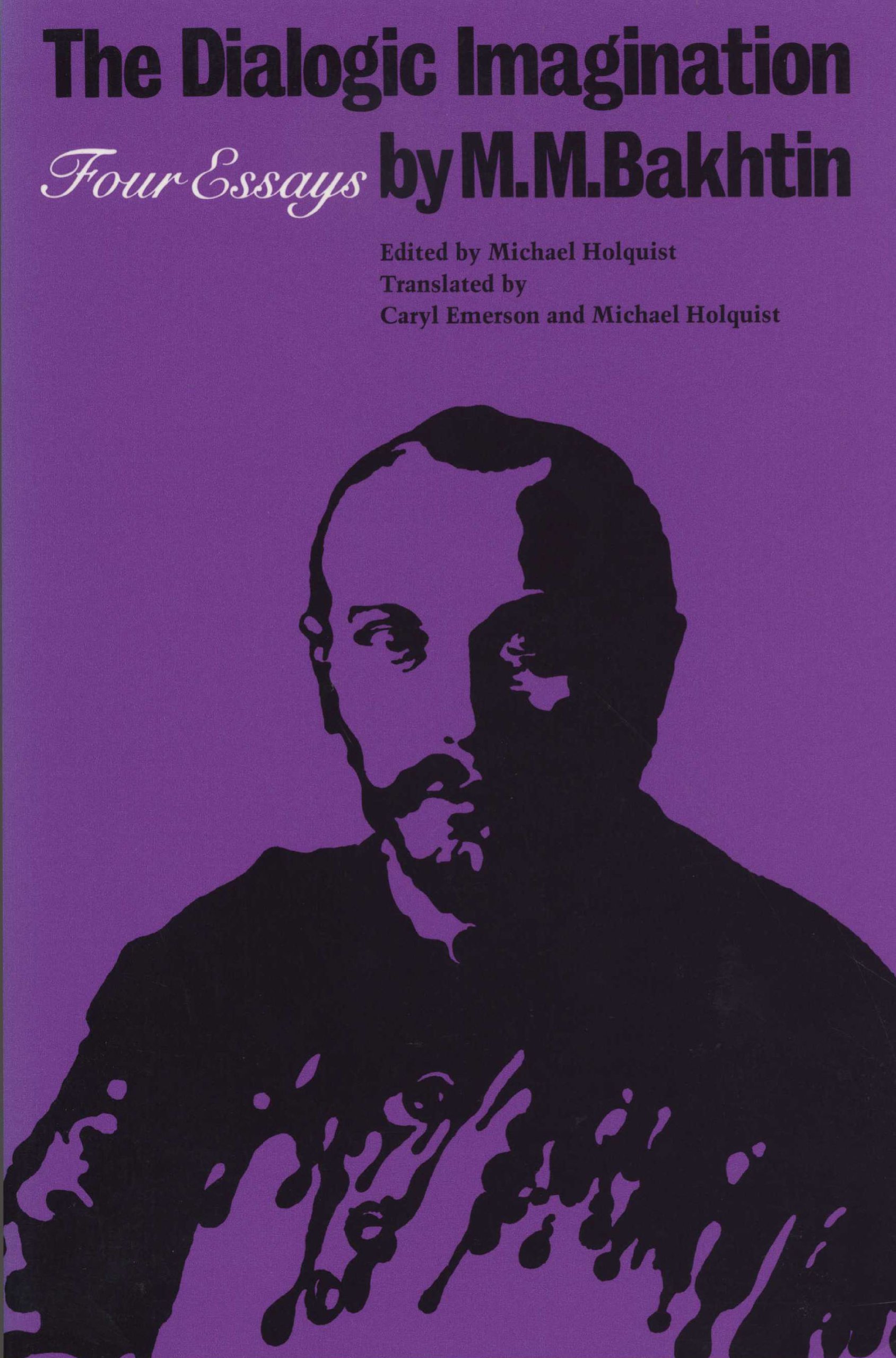
Bakhtin, Mikhail. "Discourse in the Novel."
Bakhtin frames this essay as intervention into conversations surrounding prose stylistics; Bakhtin—like Jameson after him—attempts to “overcome the divorce” (259) between ideological and formal analysis, arguing that “form and content in discourse are one” (259). In this essay, he focuses on the form of the novel, a genre “multiform in style and variform in speech and voice” (261). The novel is defined by its “heteroglossia,” or diversity in speech types. This essay is most famous for Bakhtin’s theorization of heteroglossia—the “social diversity of speech types” (263). In the novel’s inherent heteroglossia lies the underlying ideology of the form; for, in his discussion of the novel’s stylistics, Bakhtin argues for the ethico-political value of representing the plurality of speech and language in literature. According to Bakhtin, any attempt to standardize a national language is a struggle against the inherent multiplicity of registers, dialects, jargons, etc.—in short the “realities of heteroglossia” (270) in every tongue. Attempts to standardize or homogenize language—in literature and in other realms of the public sphere—develop in tandem with apparati of ideological control, the “processes of sociopolitical and cultural centralization” (271).
While heteroglossia remains a hot concept in current literary criticism (particularly in conversation with post-colonial scholars of dialect and linguistics like Édouard Glissant), his generalizations about genre are less popular. His assertion of poetry’s essential monologism, while perhaps convincing in the context of Russian epic poetry, seems ridiculous in the face of modernist and post-modernist poetics. More pertinent for me is his writing on dialogism, as it both supports and challenges assumptions about the roles of “speaker” and “listener” in conversation and literary production and reception. In mapping his linguistic philosophy on to literature and the novel more specifically, Bakhtin not surprisingly conflates the author with “speaker” and reader with “listener” (an equation that seems obvious, but that I want to complicate by examining the act of authorship figured as listening in nineteenth-century literature). He resists, however, the assumption that the listener is a passive receptacle that does not affect the speaker and his/her discourse. Listening and the attempt to understand “is active, it assimilates the word to be understood into its own conceptual system,” and the speaker orients his/her discourse “toward the specific world of the listener” and consequently “introduces totally new elements into his discourse” (282). Hence, in speech and in literature, “Language is not a neutral medium that passes freely and easily into the private property of the speaker’s intentions; it is populated—overpopulated—with the intentions of others” (294). In this way, Bakhtin challenges the active/passive and generative/receptive binaries that cluster around the categories of speaker/listener.