1media/imm_Graves_UCC_thumb.jpg2024-03-24T17:52:47-07:00Scott B. Spencer3a6e09c2eefd9ca96adbf188c38f589304cf3ce2392791Irish Minstrels and Musicians (1913)plain2024-03-24T17:52:47-07:00Scott B. Spencer3a6e09c2eefd9ca96adbf188c38f589304cf3ce2
This page is referenced by:
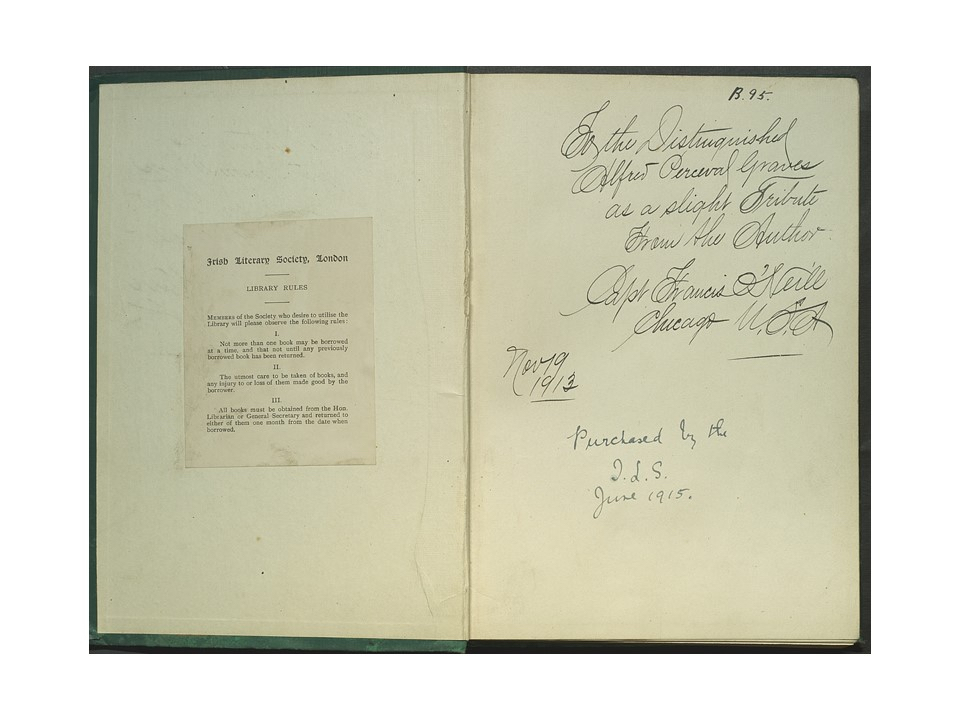
1media/Graves.webp2024-03-24T16:38:32-07:00Alfred Perceval Graves13Alfred Perceval Graves: November 19, 1913plain2024-10-20T20:44:48-07:00 To the Distinguished Alfred Perceval Graves as a slight Tribute from the author. Capt. Francis O'Neill, Chicago, U.S.A. Nov. 19, 1913
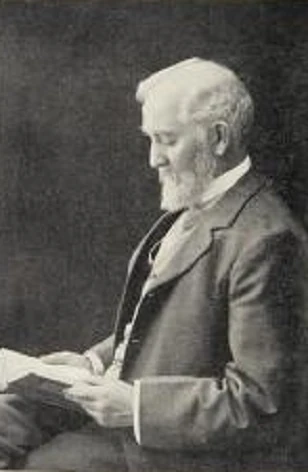
Irish poet and songwriter Alfred Perceval Graves was born on July 22, 1846 in Dublin, Ireland. His father, Charles Graves, was an educated man who held positions as professor of mathematics, president of the Royal Irish Academy, and Bishop of Limerick. Alfred Perceval Graves studied at Trinity College graduating in 1870. Following graduation, Graves worked for five years as a clerk at the Home Office, and later served as Inspector of Schools for thirty-four years (1876–1910). In 1874 Graves married Jane Cooper with whom he had five children. Following Jane’s death in 1886, Graves married Amalie Elizabeth Sophie von Ranke in 1891, which resulted in an additional five children.
In addition to his employment as Inspector of Schools, Graves was also a skilled poet and author. At the age of seventeen (1863), his first publication appeared in the Dublin University Magazine. In 1872 he published his first book of poetry titled Songs of Killarney, and was a regular contributor to the periodicals Fraser, The Spectator, and Punch. Some additional books by Graves include The Irish Fairy Book, A Celtic Psaltery, and his autobiography To Return to All That.
As a lyricist, Graves’ most popular song text is likely “Father O’Flynn,” which he paired with a traditional Irish dance tune, and was first performed by Kate Santley in 1880. Graves contributions to Irish folk music were further expanded in the summer of 1898 through the establishment of a Folk Song Society. He frequently collaborated with composer Charles Stanford providing texts for Irish folk-song collections such as Songs of Old Ireland (1882), Irish Songs and Ballads (1893), and Songs of Erin (1901). In 1928 at the request of the Pan-Celtic Congress, Graves compiled The Celtic Song Book which represented folk-tunes from the six Celtic nations, many of which utilized texts penned by Graves.
Alfred Perceval Graves passed on December 27, 1931 in Harlech, Wales at the age of 85.
References: “Alfred Perceval Graves.” Journal of the Folk-Song Society 8, no. 35 (1931): 305.
“Graves, Alfred Perceval (Obituary).” The Musical Times 73 (1932): 175.
AP (Alfred Perceval) Graves was the father of Robert Graves, the writer and WWI memoirist who wrote Goodby to All That. I’ve been wondering where the AP Graves papers wound up—he and O’Neill I think corresponded a lot: Graves was an anglo-irish aristocrat and edited the Journal of the Irish Folk Song Society. A ten page letter O’Neill wrote to Graves survives: I’ve always suspected there might be more somewhere. -M O'M
Provenance: This copy of Irish Minstrels and Musicians (1913) by Capt. Francis O'Neill is held in the Special Collections & Archives, UCC Library, University College Cork, Ireland. Special thanks to Garret Cahill of UCC's Boole Library.