Thanks for your patience during our recent outage at scalar.usc.edu. While Scalar content is loading normally now, saving is still slow, and Scalar's 'additional metadata' features have been disabled, which may interfere with features like timelines and maps that depend on metadata. This also means that saving a page or media item will remove its additional metadata. If this occurs, you can use the 'All versions' link at the bottom of the page to restore the earlier version. We are continuing to troubleshoot, and will provide further updates as needed. Note that this only affects Scalar projects at scalar.usc.edu, and not those hosted elsewhere.
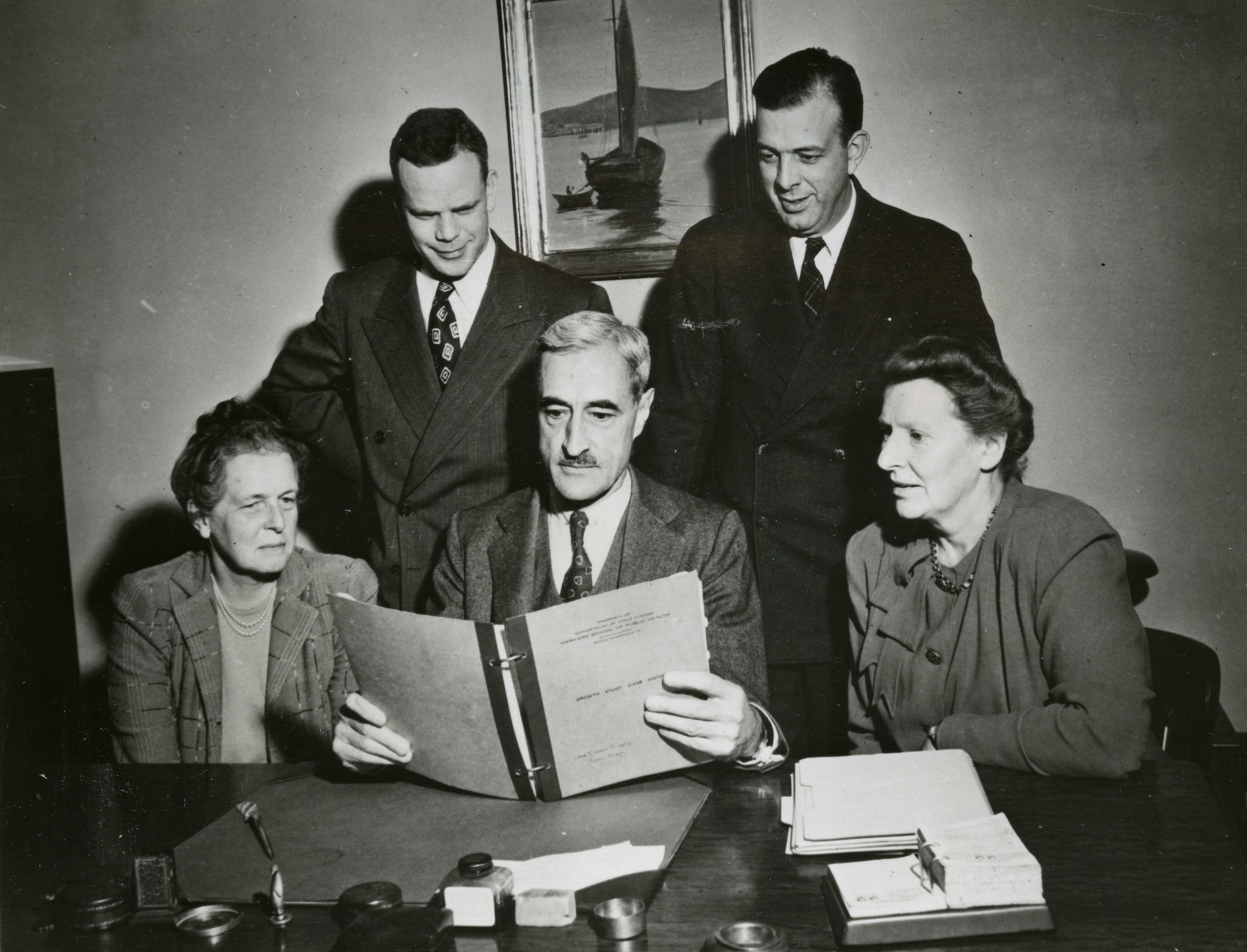
Faculty members of the Harvard School of Public Health Department of Maternal and Child Health, reading a Growth Study Case History.
12016-04-11T14:41:31-07:00Amanda Harrigan07295098f75f2d31450d0d3cb02418468fc3478681923Seated: Bertha S. Burke, Harold C. Stuart (the studies’ first Pricipal Investigator), and Elizabeth P. Rice. Standing: Samuel W. Dooley and Samuel B. Kirkwood, circa 1949, H MS c450. From the Harvard Medical Library in the Francis A. Countway Library of Medicine.plain2016-04-11T14:51:50-07:00Amanda Harrigan07295098f75f2d31450d0d3cb02418468fc34786
This page is referenced by:
1media/HSPH.jpgmedia/rsz_bridge1.jpgmedia/HSPH.jpg2016-04-11T14:34:36-07:00The Collections53plain2018-04-24T14:45:59-07:00The “Bridging the Research Data Divide” project has two work streams:
one for processing and describing historical research collections;
and one that addresses contemporary research collections, with entirely born digital research data.
early intervention studies deriving from the multisite Infant Health and Development Program (McCormick MC, 1985-2014, 5 cf, .12 GB)
and the Social transition and risk for disordered eating in Fiji study (Becker A, 2004-2010, 5 cf, .05 GB) that identified the impact of social media exposure on health.
Contemporary Research Collections
The University of Alberta Libraries has described a selection of studies that were conducted by WCHRI or MICYRN researchers. These studies are drawn from contemporary “born digital” research, and the bulk of the 39 studies we describe for this pilot are pediatric clinical trials and maternal and infant cohort studies, although other studies, such as a systematic review and a knowledge translation study, will also be described.
As well as touching on the diverse sorts of research that WCHRI and MICYRN members are doing, these 39 studies also represent a variety of statuses and conditions: some of the studies have been completed, some are still going on, and some are still recruiting participants. We’re also exploring including terminated or withdrawn trials, since these can be important for other researchers to know about, in terms of collaboration and reducing duplication of work.
In all, the Center and University of Alberta Libraries described 39 studies comprised of 390 electronic files and 135 cubic feet of analog records.
All of the research studies that both the Center for the History of Medicineand the University of Alberta are describing result from research data that cannot be replicated (as in the case of longitudinal study data). Or should not be replicated if it can be avoided (as in clinical research with children).