Japan from 1848 to 1914
7
media
2015-05-31T04:06:17-07:00
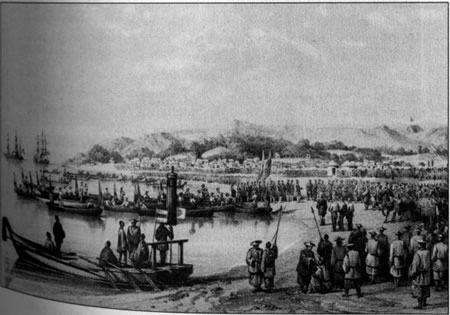
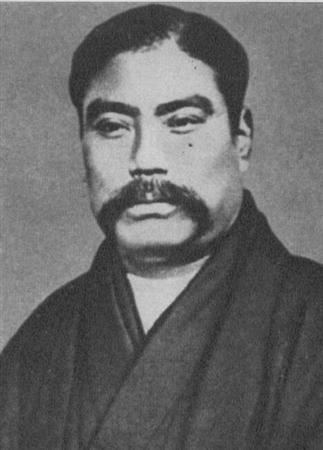
By the mid-19th century, Japan was in internal disarray. Decades of political, economic and military decline eventually led to the fall of the Tokugawa clan and the end of the 250 years of rule by the Tokugawa Shogunate. After an intense civil war, Japan stabilized in 1868 under the leadership of a young emperor, Mutsuhito, in a government that was called the Meiji Restoration. The Meiji government rapidly changed Japan’s course after 1868. The inward looking, isolationist and traditionalist Tokugawa was swept aside to make room for the industrializing, internationalist and imperialist policy of the Meiji era. What’s more, before 1868 Japan had refused to participate in the global economy, which meant that for a long time they were cut off, like China, from European and American military and industrial innovation. Not anymore. The Meiji began an aggressive campaign to build a navy on the model of the British navy. They disbanded the old system of daimayo -- or feudal -- control over military units to create an army modeled on the most powerful European land force - Prussia. Hundreds of students left Japan to study in European capitals to learn and bring back the secrets of European science and industry. A European-style telegraph network was created, railroads were built, banking was developed and factories were established, like the ones pioneered by Sakichi Toyoda, the founder of the Toyoda Company. By 1900, Japan was no longer simply copying European invention. It was inventing and innovating on its own.
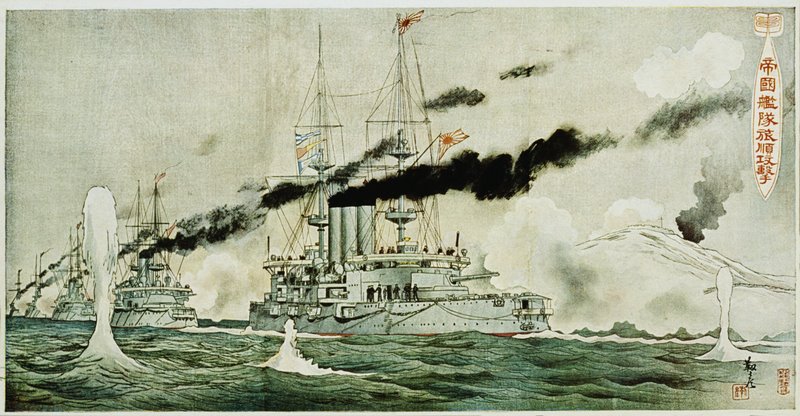
Industrial economies, as the Europeans were learning, required a horrifying amount of natural resources to maintain. Japan was soon to realize this too, and by the mid-1890s it found itself looking beyond Japanese borders for a “sphere of influence,” which, like the Europeans and the Americans, they could exploit to advance the interests of the homeland. As China weakened and the United States and European powers increased their presence in Asia, the potential sphere of Japanese influence seemed to be shrinking. By this time the Japanese knew all about the European game. You pretend to be acting in the interest of economic principles (like free trade), but beneath this veneer you apply brute military force to advance your nation’s economic objectives. In 1894, Japan with this model in mind went to war with China over the territory of the Chinese-administered Korean peninsula. Japan, now a modern military power, crushed the forces of the withering Chinese Qing Dynasty. Japan gained both the Korean Peninsula and Taiwan. In the years to come, increased instability in China led to further Japanese incursions, culminating in Japanese participation in the suppression of the Boxer Rebellion in Beijing in 1900.