Thanks for your patience during our recent outage at scalar.usc.edu. While Scalar content is loading normally now, saving is still slow, and Scalar's 'additional metadata' features have been disabled, which may interfere with features like timelines and maps that depend on metadata. This also means that saving a page or media item will remove its additional metadata. If this occurs, you can use the 'All versions' link at the bottom of the page to restore the earlier version. We are continuing to troubleshoot, and will provide further updates as needed. Note that this only affects Scalar projects at scalar.usc.edu, and not those hosted elsewhere.
Woman Life Freedom Uprising Main MenuWoman, Life, FreedomIran, Islam & the InevitableContextualizing the Islamization of IranThe Making of the Modern WomanIcons & Personas of Woman Life FreedomOrigins of the UprisingFreedom through the FemaleThe Writing in the MarginsNasleh Zed's Youthful UprisingSoundtracking Woman Life FreedomUrban Canvases of the UprisingFeminist Placemaking of a Digital UprisingAfterlives of Woman, Life, FreedomWLF ResourcesHere you will find our sources all compiled in one placeNahid Siamdoust - UT Austin Iran Collab Networka897e5b6082169b816946b1032f8b3c01e62c1ee
Government study shows that Iranians now less religious | WION
12024-12-02T02:02:13-08:00Asal Khers 8fe2adde84e1fbd5622a773ff45de6e34c901d40458711An interesting study is coming up from Iran, according to the study by the Ministry of Culture and Islamic Guidance, there has been ...plain2024-12-02T02:02:13-08:00Asal Khers 8fe2adde84e1fbd5622a773ff45de6e34c901d40
This page is referenced by:
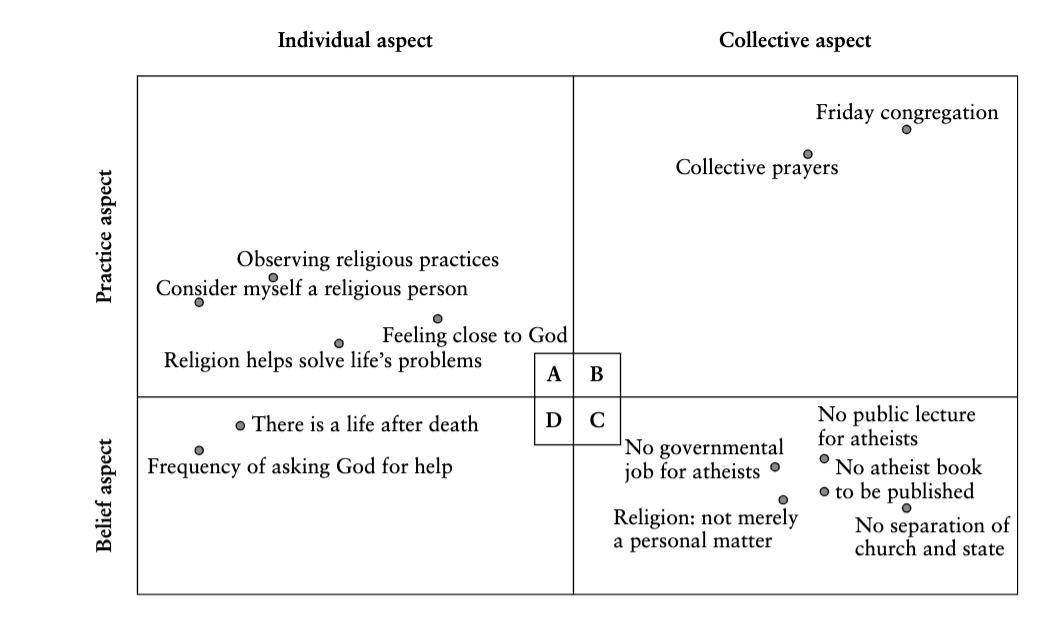
1media/Screen Shot 2024-10-27 at 5.29.11 PM.png2024-10-27T13:42:50-07:00Secular Streets18The Practice of Islam Significantly Declining Among Iranians, Especially the Youthimage_header2024-12-08T14:24:28-08:00Iran's youth have become less religious due to the relationship of faith now being deeply connected to social and political issues. This is changing the generation's attitudes toward religion in a negative direction. Although the Islamic Revolution of 1979 was “cited as evidence of the return of religion in the modern age,” the practice of religion has declined significantly among Iranians, especially the youth (p.115). Kazemipur makes an argument with the “rational-choice theory,” a new framework that states citizens approach religion in a calculated manner, based on what is best for themselves and their benefits versus their losses (p. 116). Statistical measurements from the NSVA survey of 2000 were applied to multidimensional scaling, comparing people's beliefs, practices, and individual and collective aspects of religion. The most significant area of this chart is Zone C, showing that societal and political implications had a strong presence in people’s religious beliefs (Page 119). Iranian youth do not want to engage in traditional practices because these no longer represent religion. Instead, they symbolize the political state and restrictions on personal freedom.
In addition, Kazemipur presents another data analysis, showing that “all the correlation coefficients between the conventional dimensions of religiosity and the religio-political dimension are negative” (p. 120). This evidence highlights that as young Iranians become more involved in the politics of Islam in the government, they increasingly distance themselves from conventional religious practices. In 2000, those who “never participate in collective prayers” jumped from 0 to 49 percent (p. 122). Iranians are viewing religion as the root of their oppression, causing them to reject the religion altogether.
Women have also become targets of the oppression stemming from certain interpretations of Islam, facing increasing adversities such as lack of education, restricted marriage rights (including divorce and polygamy), and more (p. 148). When the youth links practicing their religion as standing in opposition to these damaging issues it only decreases the affiliation rate. What they used to practice has become associated with the very issues they seek to escape.
- K.A.
References:
Wellman, Rose. “Sacred as Secular: Secularization Under Theocracy in Iran, by ABDOLMOHAMMAD KAZEMIPUR.” Sociology of Religion 84, no. 2 (January 5, 2023): 234–35. https://doi.org/10.1093/socrel/srac041.