Introduction
By the closing panels of the
twelfth and final issue of Grant Morrison and Frank Quitely’s All Star
Superman, Superman has definitely thwarted his recurrent nemesis Lex
Luthor, defeated a “tyrant sun” with apocalyptic intentions, and received a
passionate kiss from his great love, Lois Lane.
But there is a problem with this tableau: it’s less a happy denouement
than the moment before Superman has to save the world yet again. The aforementioned tyrant sun, Solaris, has
doomed earth by turning the yellow sun blue, and worse still, thanks to an
overdose of solar radiation engineered by Luthor in the first issue of All
Star Superman, Superman’s cells are rapidly converting into pure
energy. In short, Superman, the world’s
only salvation, has mere moments to restart the sun’s heart and save the world
before he dies. Of course, as Lois
reminds Superman and his readers, “that’s more than you ever needed” (Morrison
288-9). In the succeeding panels, we see Superman speed through space, plunge
into the sun, and return nature to its status quo.
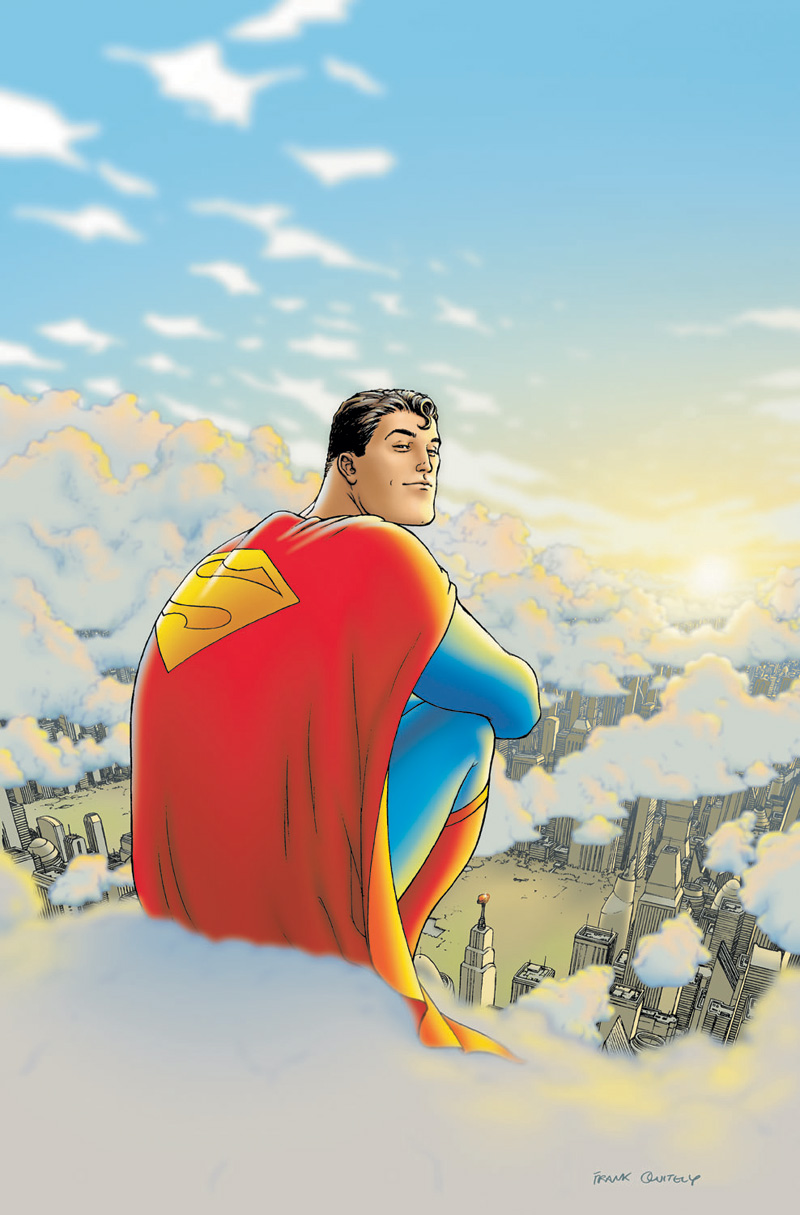
The splash page that follows (Fig. 1) serves as the perfect resolution to a Superman story that envisions the character’s
death. Specifically, Morrison and
Quitely present a golden image of Superman, toiling within the great engine of
the sun, saving the world – in perpetuity (292). Other heroes may get to ride off into the
sunset when they finish righting wrongs and rescuing damsels, but Superman is
different; Superman flies into the sun itself. In exploring how Superman’s life might end,
Morrison and Quitely suggest here that it simply does not. Even after Superman
“dies,” he continues to fulfill the role of savior. The parting image of the sun and its longtime
benefactor and champion joined in common purpose implies transcendence, an
afterlife. It is a sophisticated
meditation on the superhero fantasy, which obviates the cynicism and violence
that so often defines other “sophisticated” modern superhero comics, and
ultimately shrugs at those same comics’ existential questioning of the
superhero.

This equation of
sophistication with dark plot elements and morally flawed characters mostly
derives from the massive influence of Alan Moore and Dave Gibbon’s 1986 graphic
novel, Watchmen, over the entire genre of superhero comics. As the only graphic novel included in Time’s
“All-Time 100 Novels,” book critic Lev Grossman defends Watchmen’s
inclusion for its “ruthless psychological realism…[and] cinematic panels rich
with repeating motifs,” and describes it as “a watershed in the evolution of a
young medium”
(Grossman). Moore’s narrative
highlighted the limits of the superhero fantasy within a socio-political setting
closer to our own reality; however, the stylistic complexity of Watchmen
helped to distinguish the unique formal strengths of comics, and opened the
medium up to deeper interpretations, more complex exploration of themes, and
new presentations of those themes and interpretations. It remains one of the best selling books to
feature men and women in tights and capes, and its praise is well deserved.

However, Watchmen’s exposure
of the psychoses and neuroses that seem to undergird any individual donning a mask
and fighting crime also seems to have circumscribed the ability of the genre to
tell stories unlabored by a postmodern pessimism about the superhero fantasy in
general. Narrowly construed, the
so-called “watershed moment” Grossman identifies has lead to both the
“deconstruction” of the superhero, and an increased presence of what has often
been described as “gritty realism.” Watchmen’s
gritty realism results in an increased presence of violence, sex, and moral
ambiguity, but offers substantive discourse on the implications each of those
elements. Many subsequent comics, hoping to repeat the commercial and critical
success of Watchmen, include the grit, but fail to offer meaningful
exploration of said grit, thereby attenuating any claims of “realism.” These reactionary “after-Watchmen”
comics seem intent on highlighting the same weaknesses of the genre that Moore
and Gibbons definitively exposed in 1986.
But how can we identify “post-Watchmen” comics? That is, where are the stories, mindful of Watchmen’s
lessons and themes, that push against the apparent limits established by Moore
and Gibbons, that reject the simplistic “dark is sophisticated” paradigm, and
attempt to uncover new revelations about our relationship to the superhero? Identifying post-Watchmen texts is
crucial if fans and scholars of the genre alike want defend superhero comics as
both innovative and able to reflect current tensions, anxieties, and
desires. If Alan Moore and Dave Gibbons
answered all of the genre’s foundational questions in 1986, what point would
there be in reading subsequent titles, let alone engaging those titles
critically? Therefore I turn once more
to Grant Morrison and Frank Quitely’s All Star Superman, and suggest
their graphic novel as exemplary of the qualities, mentioned above, which I
believe must define post-Watchmen comics. All Star Superman possesses all the
literary and aesthetic aspirations of Watchmen, but without any
pretensions toward realism, or attempts to deconstruct the superhero – a
dubious project at best.
| Previous page on path | Contents, page 1 of 5 | Next page on path |
Discussion of "Introduction"
Add your voice to this discussion.
Checking your signed in status ...