The Gender Count
As part of my research, I decided it was necessary to make a count of all the most prominent characters on each of my chosen programs, and then to separate them by gender. I’ve stuck to the binary, mostly because there are really no cases of gender ambiguity within these main characters. There are probably cases of that within the dozens of supporting and minor characters that I could also examine, but as these are the main players, I’m just going to analyze them.
Character selection are taken from the individual FanWiki pages for each program; I took down only the ones that are listed as main characters, with a few additions and omissions as I saw fit.
Also note my use of “boy” and “girl” as the pronouns, instead of “men” and “women” or “males” and “females;” I feel that male and female are too technical and biologically-rooted for my purposes, and seeing as most of these characters are indeed children, I’ll stay away from the pronouns intended for adults.
Rugrats
Boys: 4
Tommy, Chuckie, Phil, Dil (season 6 onward)
Girls: 4
Lil, Angelica, Susie (season2 onward), Kimi (season 7 onward)
(Omitted: Spike, the dog)
The main characters in Rugrats are easy enough to decipher. It’s an ensemble cast, with all of the main babies (Tommy, Chuckie, Phil, Lil, Angelica) getting approximately the same screen time. I struggled over whether to include Susie and Kimi in this list, because Susie only appears in some of the episodes, and Kimi is such a late addition to the main group, but they ARE crucial to the overall plot and appear in the spinoff All Grown Up, so I kept them. So, we have a pretty even split between boys and girls, with four of each, even though there are discrepancies. Lil is the only protagonist girl in the main cast, since Angelica is firmly in the antagonist category for most episodes. Kimi starts to balance things out, but she is, again, only present for the last three seasons. And Susie is, in my opinion, more of a supporting character even though the listings state otherwise, which is disappointing because she is the only black baby in the cast and the only POC until Kimi comes. Dil makes the list because of the sheer impact he has on the show (his arrival was its own movie, for God’s sake), but for all of the season in which he appears, he is an infant, incapable of speaking, walking, etc.
I omitted Spike because he’s literally a pet dog, and speaks only once in a episode that turns out to be a dream, and in the film Rugrats Go Wild (in which he is speaking to Eliza Thornberry of The Wild Thornberries, who can talk to animals).
Rugrats is also one of the programs in my focus that does not have a gendered title; instead of using one of the characters’ names and outright designating them the main character, the show maintains an air of more equal distribution by using a neutral title.
Hey Arnold!
Boys: 2
Arnold, Gerald
Girls: 1
Helga
Hey Arnold!, by contrast, is titled for its one main character, and as such, almost all of the episodes follow him and his adventures. The other two characters listed as “main” are Gerald, Arnold’s black best friend (one of the only POC in their fourth-grade class), and Helga, Arnold’s antagonist and secret admirer. This list doesn’t seem exhaustive to me, since so many episodes also involve their other classmates, but it’s true that only these three appear together in every single one. It’s a very short list, so there isn’t much to say beyond that I would love if more of the great female characters on this program got more screentime.
Also, I appreciate the effort to have different kinds of people as the main characters, but I can’t decide if it feels more like real representation, or like the standard White Protag, POC Sidekick, and Token Girl setup.
As Told By Ginger
Boys: 3
Darren, Carl, Hoodsey
Girls: 5
Ginger, Dodie, Macie, Courtney, Miranda
(Omitted: Lois Foutley, Ginger’s Mom)
While having a solidly main-character-driven title, As Told By Ginger stands out as the only show in my focus area that has a single female lead. Ginger is the main character without question, and I think that this list is a solid representation of the main characters. We also have here the only majority of girls, which is both a good thing and something to consider carefully.
Darren, Ginger’s best friend and eventual love interest, is a POC, which is refreshing to see, but he doesn’t appear nearly as much as the women on the series. Courtney and Miranda (who is a WOC) are in most episodes, but they are largely antagonists. I’ve still included all three of these characters for their prevalence and contributions to the plot. I omitted Mrs. Foutley because there are no other parents included as main characters, though many characters’ parents appear in the series.
I say that the majority of girls here (five, to three boys) is worth questioning because of the marketing intentions for the show. Ginger was promoted as a show for young adolescent girls, and only girls. Other programs that have male or gender neutral main characters are generally marketed for boys or for all children, but this show is only for girls. What makes a program with a female lead intrinsically only for girls? Well, sexism in the industry (in film, TV, and yes, in cartoons) leads many producers to believe that boys will not watch shows that star girls. And the sexism that exists in mainstream society and is propagated by media but also by parents (who likely mean well but are actually causing more trouble) makes this idea a reality. It’s no wonder, then, that Ginger is a show that far fewer folks remember as compared to its male-led contemporaries.
SpongeBob SquarePants
Boys: 5
SpongeBob, Patrick, Squidward, Mr. Krabs, Plankton
Girls: 1
Sandy
(Omitted: Karen, Mrs. Puff, Pearl, and Gary the Snail)
Ahh, yes. Here we have it, the most successful Nicktoon of all time, and despite all the criticisms I’m about to make, my all-time favorite. SpongeBob fits neatly into the mainstream of cartoons: titled after its male protagonist and featuring a main cast of mostly male characters. This show has one of the worst numerical distributions, five boys to two girls. I really debated whether or not to include Karen, Plankton’s computer wife, because though she’s female, she is a computer, and she doesn’t even appear in all the episodes that Plankton does. Ultimately, for fairness’s sake, she was cut, along with other female characters in the same predicament. And even with her, the ratio would only be five to two.
Sandy is a little bit of a trope character, anyway. She is a “one of the guys” kind of female character, smarter and more capable than any of the men, but still belittled and teased by them. Even as a kid, I would feel so frustrated on her behalf when she had to clean up SpongeBob’s messes just by virtue of being the most adult person on the whole show.
SpongeBob is also unique on my list of shows in that none of the characters are human. They’re sentient sea creatures, which makes the concept of gender really unnecessary in their world. SpongeBob himself is constantly shown subverting gender norms, and there was a massive scandal about ten years back involving fundamental Christians’ concern that SpongeBob is meant to be a homosexual. I would bet a good amount of money that that was never the intention, but there are many episodes that, on purpose or not, are great explorations of gender and sexuality.
I omitted the characters listed above because their number of appearances on the show are far fewer compared to the others.
The Fairly OddParents
Boys: 4
Timmy, Cosmo, Poof (season 6 onward), Sparky (season 9)
Girls: 3
Wanda, Vicky, Chloe (season 10)
Last but not least, The Fairly Oddparents. This show has a decent distribution of characters, no matter which way you look at it. Originally, I wanted to include only the four main characters that have been included in all ten seasons: Timmy, Cosmo, Wanda, and Vicky. That would place the ratio at an even 2:2, which is appealing to make the results of this survey look good, but I think that including Poof (Cosmo and Wanda’s fairy son), Sparky (Timmy’s magical dog, added in season 9 and removed for season 10 due to poor reception), and Chloe (a new neighbor who now co-owns Cosmo and Wanda with Timmy) is important. All of these characters were added to the main cast and appeared/appear in most, if not all, of the episodes following. Though Sparky is a dog, he remains on the list because he is personified to be able to speak and use magic.
Outside of this research, I have not watched many of the episodes with Sparky or Chloe, and the ones that I have seen have a significant drop in show quality compared to the earlier seasons. Creator Butch Hartman defended their addition to the show by stating that the audience needs more variation in characters, especially in a show that has been running for so long. I don’t mean to be a downer for the first time in this analysis, but if the only thing that is keeping a show alive is changing up the rules for the entire basic show-universe, then maybe it’s time for the show to end.
TOTALS:
Boys: 18
Girls: 14

Totals without As Told By Ginger:
Boys: 15
Girls: 9
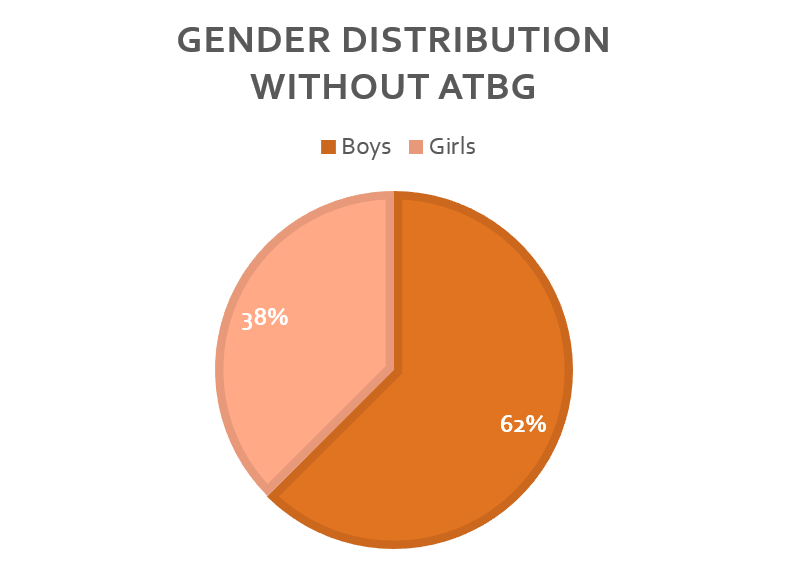
Note: As I was doing these reviews, I noticed the major impact that ATBG had on the number of female characters, so I wanted to also include the numbers without that program. I think it’s important to say openly that I included ATBG in this research because I knew it had good representation of girls, and I wanted to have at least one positive sample.
(Thompson 1997; Thompson 1995; Stevens)

