Weighing Scales
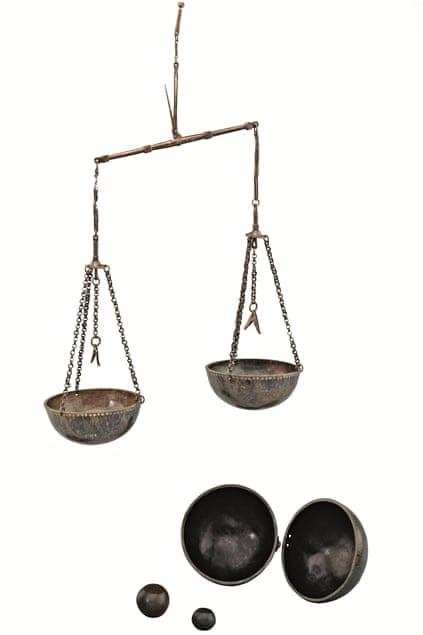
Balance scales such as these proved to be a very important tool for Norse trade. Before the Norse were relying on coins as a measurement of value, Scandinavia’s contact with the Islamic world introduced the usage of scales and weights to determine the value of an object and the appropriate payment. Weights for these scales often came from pieces of furniture in churches or monasteries and were soaked in a specific amount of lead depending on the necessary weight.1 This was not however a standardized process throughout the area, and weights of different materials, shapes, and sizes have also been discovered.2 These weights and scales are often uncovered among traded goods and other objects that
indicate close proximity to trading areas.
The discovery of balance scales provides some evidence of the trading centers described in Norse Sagas.3 But more often than not, obvious finds such as weights or coins are not the sole deciding factors in determining an area as a place of trade. Archeologists must use the geography of an area in tandem with the discovered artifacts, such as locations at the mouth of a river or near arable land, as well as written texts to hypothesize places of trade. The control of trading centers played a significant role in the start up of political centers, especially in the North, as this control was a window into the economy of the rest of Western Europe and beyond.4
Trade was also crucial to developing relationships with other peoples. For example, Finnish trading centers and routes allowed them to ally with those on the Russian Arctic coast, those who lived on the coast of the Black Sea, as well as Mediterranean peoples. The Finnish, who are often considered to be on the outskirts of Norse society, were actually major trading partners with Norse eastern trade because of their accessibility to resources from the wider world. Perhaps they were most valued for their fur and iron, which became increasingly important to the rest of Scandinavia as well as Europe through trade facilitated by weighing scales.
Even when the Norse started to use coins, they valued them largely for their weight in silver and gold, and continued to use scales such as these in trade.5 As simple as weighing scales may have become in the modern day and age, they facilitated much of this trade during the Viking Age and therefore indirectly played a role in increasing political power.
indicate close proximity to trading areas.
The discovery of balance scales provides some evidence of the trading centers described in Norse Sagas.3 But more often than not, obvious finds such as weights or coins are not the sole deciding factors in determining an area as a place of trade. Archeologists must use the geography of an area in tandem with the discovered artifacts, such as locations at the mouth of a river or near arable land, as well as written texts to hypothesize places of trade. The control of trading centers played a significant role in the start up of political centers, especially in the North, as this control was a window into the economy of the rest of Western Europe and beyond.4
Trade was also crucial to developing relationships with other peoples. For example, Finnish trading centers and routes allowed them to ally with those on the Russian Arctic coast, those who lived on the coast of the Black Sea, as well as Mediterranean peoples. The Finnish, who are often considered to be on the outskirts of Norse society, were actually major trading partners with Norse eastern trade because of their accessibility to resources from the wider world. Perhaps they were most valued for their fur and iron, which became increasingly important to the rest of Scandinavia as well as Europe through trade facilitated by weighing scales.
Even when the Norse started to use coins, they valued them largely for their weight in silver and gold, and continued to use scales such as these in trade.5 As simple as weighing scales may have become in the modern day and age, they facilitated much of this trade during the Viking Age and therefore indirectly played a role in increasing political power.
| Previous page on path | Sophie Bokor, page 4 of 4 | Path end, return home |
Discussion of "Weighing Scales"
Add your voice to this discussion.
Checking your signed in status ...