Scalar's 'additional metadata' features have been disabled on this install. Learn more.
Synth-GuideMain MenuPrefaceChapter I: Subtractive Analog SynthesisChapter II: Frequency Modulation SynthesisChapter III: Sample-based SynthesisChapter IV: Transitional SynthesisChapter V: Physical Systems Modeling SynthesisAppendix I: TimelinesAppendix II: Audio FilesJohnny Gossick6d6d730f128fa333cdfaff86ec305fa4f7d28c44
Wavetable as Sound Source
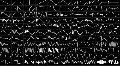
12016-06-19T20:10:12-07:00Johnny Gossick6d6d730f128fa333cdfaff86ec305fa4f7d28c4498622plain2016-06-19T20:33:42-07:00Johnny Gossick6d6d730f128fa333cdfaff86ec305fa4f7d28c44A wavetable (pictured below) is a collection of short periodic waveforms. In wavetable synthesis, different short waveforms are combined to make longer and more complex ones. These complex waveforms become the sound source for a wavetable synth.
12016-06-19T20:27:56-07:00Visual Representation of a Wavetable2Visual representation of a wavetable with several different waves stored in it. Table is from the Circle soft synth by Future Audio Workshop (Synthesizer Academy)media/wavetable-synthesis-wavetable.gifplain2016-06-19T20:28:21-07:00