Scalar's 'additional metadata' features have been disabled on this install. Learn more.
Digital Exhibits: Ancient Art 203
Main Menu
Ancient Art
Table of Contents
Sample Exhibit - Herakles in Greek Art
Depictions of Herakles in Greek Art
Angyal- The Culture of Pre-Columbian Times
This exhibit displays the important symbols culture during ancient Pre-Columbia.
Aversa- Ancient Faces
The collection includes portraits of many Ancient faces made of marble, limestone, bronze and black basalt.
Brookes - Sculptures Of The Gods
A look at Sculptures of Gods during the classical and hellenistic period of Greek history. This will tell you the stories of the Gods being shown and the growth of realism during this period.
CERMINARA-Ancient Greek Figurines
Exploration of different Terracotta figurines from ancient Greece
Cooke -- Black Figure Art from Ancient Greece
This page will highlight some works that were made using black figure, which is named for the color of the figures depicted in the art.
Costa- Death and Afterlife
Foley - Statues and figures of Greek Mythology
My theme is Greek Mythology in the forms of statues and figures
Fowler
How the human body is depicted through Ancient Art
Harris - Greek Athletes
The Olympian games began in Greek times. These pieces will depict Greek Athletes doing the games
Joseph - Hellenistic Art
The Hellanistic art style focuses on realistic, natural human forms. Straying away from the rigid unnatural forms of ancient sculpture styles before it.
Lamon- Mythical Creatures in Greek and Cycladic Art
This exhibit will take a look at how Mediterranean civilizations depicted a few mythical beasts throughout different periods.
Leszczynski - Late Minoan, Creature, Covered, Gems
A collection of Lentoid gems engraved by Minoan craftsman. Some served a useful purpose as seals. This collection spans the Late Minoan I-II period to the Late Minoan II-IIIA period.
McDonough - Medusa in Ancient Greek Art
A look at one of Greek mythology's most feared creatures
Meehan - Ancient Spartan Art
Popular Art and Customs of Sparta and Laconia
Nelson - Ancient Egyptian Statues
This digital exhibit displays a collection of statues from Ancient Egypt
Ramos- Marble Figurines
Females figurines are an important part of ancient Greeks art history .
Raquet- The Acropolis Reunited
Putting the Parthenon back together
SHORT - Representations of the Minotaur and His Story
SmithKali - Depictions of the Human Body
Starrs--Art of the Trojan War
A sampling of pottery inspired by the mythical Trojan War.
Wible - Aphrodite
My theme is the representation of Aphrodite through different types of art.
Danielle Bennett
672675c081461104799d4151a54a1faf0c800419
Centaur
1 2017-10-12T09:49:32-07:00 Teagan Lamon ffb9a2656af01f124a23b011f9a7fc57a05bdf30 21307 1 plain 2017-10-12T09:49:32-07:00 Teagan Lamon ffb9a2656af01f124a23b011f9a7fc57a05bdf30This page is referenced by:
-
1
2017-10-12T08:48:45-07:00
Lamon- Mythical Creatures in Greek and Cycladic Art
18
This exhibit will take a look at how Mediterranean civilizations depicted a few mythical beasts throughout different periods.
plain
2017-10-13T11:24:08-07:00
This exhibition will give the audience a look at how Greeks portrayed their mythological creatures in different styles throughout different stylistic periods. The exhibit ranges from pieces in the Geometric period in the 8th century B.C. to pieces from the Classical Greek period in the 5th century B.C. The audience will take a look at two specific beasts from Greek mythology; the centaurs and the Minotaur and examine the differences in their portrayal in different periods, mediums, and styles.
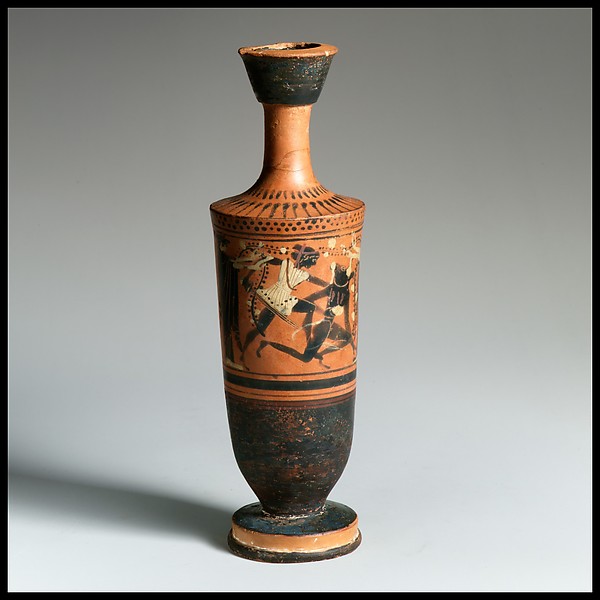
The first piece on this page shows Theseus slaying the Minotaur while between two female figures. The scene is depicted on a terracotta lekythos that typically contained oil in the Greek world. At a quick glance it is plain to see that the piece is done in a very typical Archaic style; black figure, where the slip is painted onto the clay in the shape of the figures before it is fired in a kiln to create the color difference between the clay and the scene. Another key attribute to black figure that is seen all throughout the Minotaur and Theseus (especially around the Minotaur's head and Theseus' sword) is the inscribed details that break up the black figure and make the images look more realistic although the Greeks have still not fully found how to show scale. The lack of ability to scale the figures is clearly seen in the slenderness of the Minotaur that is supposed to be an imposing beast who had killed hundreds of Athenian youths before Theseus conquered him.
The next piece still features the Minotaur with Theseus on the flip side but there are quite a few key differences that can easily be seen between the two pieces. The first difference is in the pottery itself. This second piece is a skyphos, which was used as a deep drinking cup, this gave the artist a broader space to work with than the lekythos in the prior piece. The next couple of differences are seen in the style of the pieces. This piece is from the Classical period where artists tend to focus more on the figures themselves rather than the story being told as they had in stylistic eras before now. The second and probably more important stylistic change between the two is that this piece is done in red figure which is basically the opposite of black figure. The slip is painted onto the negative space and used to create the details like the Minotaur's facial features, muscles and other contrasting lines throughout the body. The Greeks have also developed more control of their art between the Archaic and Classical and have begun to emphasize realistic depictions of figures even more so than they had in the past so the Minotaur looks much more physically imposing.
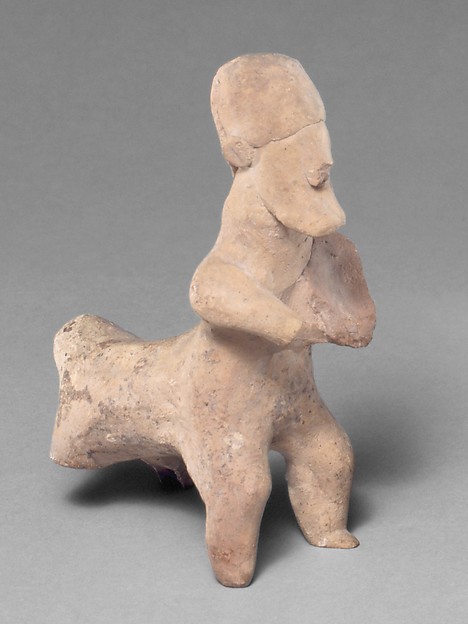
The exhibit will now take a shift from the Minotaur to centaurs which are half horse, half human creatures. The first piece we will look at is the only piece that doesn't come from a known Greek settlement and from a culture that we have not studied this semester. The "Centaur" comes from Cyprus, an island in the Mediterranean that was at one point settled by the Mycenaean's and is said to be from a tomb. The piece is from what is known as the Cypro-Archaic II period which is attributed to the years of 600-475 B.C. Despite the time difference the piece looks very similar to the "Male 'lyre player' figurine" that we have seen a lot this semester and was created between the years of 2600 and 2300 B.C. The two pieces both show very little detail in either the face or body with the exception of the emphasis put on the nose. The one real difference between these two pieces is that the lyre player is made of marble while the centaur is made of terracotta. I found this piece to be very strange since it was created towards the end of the Archaic period but it still maintained the Cycladic style that was shown thousands of years before.
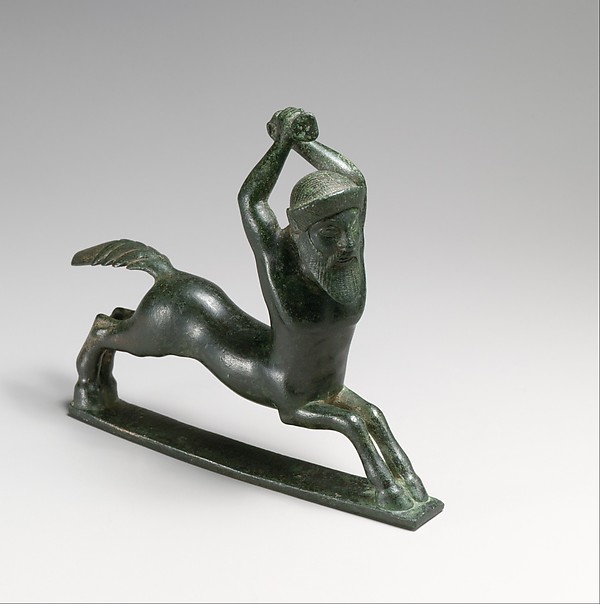
The second centaur piece shows a centaur being defeated in battle by a man (there is a small bit of a spear in the centaur's side.) This is a common scene in Greek art as centaurs were typically seen as the heal to civilization and a threat to Greek society. This is very different than the way Centaurs were presented in Cyprus where centaur sculptures are typically found in tombs or sanctuaries which suggests that they may have been religiously significant to the Cypriots. The piece is made of bronze that was cast upside down which is why there is a base at the feet of the figures and why the centaur's tail touches the ground and is said to have been found at Olympia. Although this piece is older than the centaur sculpture from Cyprus it is undoubtedly more detailed. There are clear details for eyes and mouths and while the Greeks are still searching for realism, especially in the mythical creatures, they are beginning to show more defined extremities.
The fifth and final piece in the exhibit is a third centaur piece that truly shows the detail that Greek artists ended up becoming capable of producing by the end of the Archaic period. The piece is another bronze cast figure of a centaur, but this time the figure is in an active pose and seems as though it is running wit what was meant to be a spear in his hand. Not only is the pose pulled off extremely well by the artist but the attention to detail in the face, hooves and tail are astounding. The figure is so well made that it impossible to misinterpret the figure as anything but a centaur and is in my research one of the most realistic depictions of a non-real creature of the time.