The Knotted Line, a tactile exploration of freedom and confinement, powered by Scalar

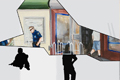
Screen shot from The Knotted Line

A screen shot of The Knotted Line's tactile interface.

Another new Scalar project: The Knotted Line, a “tactile laboratory” created by artist/educator Evan Bissell that explores the nature of freedom and confinement in the United States. True to its name, The Knotted Line represents the intertwined histories of incarceration, education and labor through a collection of miniature paintings by Bissell depicting over 50 historical moments, all connected by a flowing, interactive line that can be pushed, pulled, and opened to reveal the imagery and content inside. This dynamic interface, designed and developed by ANVC’s creative director Erik Loyer, is almost wholly driven by material authored in Scalar—the first project to use Scalar in this way.

Screen shot from The Knotted Line

Scalar's default reading interface is used to present expanded content, embedded media, and educator resources.

Each painting of The Knotted Line is annotated with brief glosses which introduce the historical event it depicts, and then link to an expanded treatment of the event in Scalar’s native reading interface, featuring embedded videos, images, and resources for educators. The complete timeline, which focuses on the geographical area of the United States, covers over 500 years of history, including some hopeful speculation about future events.

The Knotted Line shows the versatility of Scalar in the way in which it uses the same store of content to drive radically different, yet complementary presentations. Scalar’s ability to add arbitrary metadata using popular ontologies like Dublin Core and ArtSTOR made it possible to include the temporal and spatial coordinates needed by the tactile interface, while still keeping content visible and editable within Scalar’s default presentation.

Because of the visual, pedagogical, and historical nature of its content, The Knotted Line represents a dataset with its own creative potential for remix and reuse. To encourage this, the project’s creators have included a “Data Sources” path which explains where to find useful resources like 300 dpi versions of each painting, an XML file that defines every point of the “knotted line” itself, and more—a great example of how the open access philosophy behind Scalar enables projects to function simultaneously as publications, websites, archives, and services. As a result, the potential exists to reformat The Knotted Line as a poster, a game, or some unforeseen mashup with another data source; we’re excited by the possibilities.

Posted in Uncategorized | Leave a comment

Scalar-based complement to Matthew Delmont’s The Nicest Kids in Town launches

Screen shot from The Nicest Kids in Town Digital ProjectWe’re happy to announce that the latest Scalar publication to go live is the digital companion to Matthew Delmont’s new book The Nicest Kids in Town (University of California Press), which explores American Bandstand’s discriminatory policies against black youth in Philadelphia—contrary to the claims of host Dick Clark that he integrated the show in its early years. Delmont’s digital project features over 100 images and video clips, including memorabilia, newspaper clippings, and vintage clips from American Bandstand. The Scalar publication first began to take shape at the NEH Institute for Advanced Topics in the Digital Humanities in Summer 2011.

Delmont’s project uses Scalar’s “paths” feature to organize his material into three main sections: “Bandstand’s Local Years: 1952-1957,” “America’s Bandstand: 1957-1964,” and “Remembering American Bandstand,” each replete with media illustrations. Scalar radial visualization for The Nicest Kids in Town digital projectAs the screen shot above (taken from one of Scalar’s built-in visualizations) illustrates, media (shown in green) comprises roughly 3/4 of the discrete content elements in the project, and is extensively referenced (media links are represented as green arcs).

Delmont recently spoke about his research on Democracy Now! with Amy Goodman and Juan González.

Posted in Uncategorized | Tagged , , , , , | Leave a comment

Compatible Data Initiative Highlights Workflows between Archives, Linked Data, and Authors

Wordle: DBI MeetingCompatible Data Initiative Wordle by Elizabeth Cornell

ANVC’s Craig Dietrich joined a group of scientists, humanists, and archivists for a weekend at the New York Public Library to discuss workflows between digital archives, linked data, and authors. At the Compatible Data Initiative conference, Dietrich presented Scalar’s use of XSLT and RDF technology to seemlessly bridge the platform with partner archives including Critical Commons and the Internet Archive. He concluded his talk with a call for publishing platforms to encourage responsible use of media through import features that maintain metadata records and templates that balance voice in both text and image.

Dietrich co-presented with UMaine Still Water co-director Jon Ippolito, who featured the Metaserver, an emerging tool for linking records across archives.

Both Scalar and the Metaserver can point to resources without needing to create a local copy, meaning they can outsource the labor of updating references to the various collections to those curators who are in a better position to do so. And both are free and open-source software. (Still Water blog)

Posted in Uncategorized | Leave a comment

Scalar presented at IEEE’s Semantic Computing Conference

On Monday Craig Dietrich presented the digital humanities topical keynote at IEEE’s Semantic Computing Conference, Stanford University. He provided an overview of work in the digital humanities centered around properties public, duplicable, and interpretive, with examples including projects being produced in ANVC partner archive HyperCities. The presentation concluded with a discussion of Scalar’s use of semantic web technology and a challenge to the fields of digital humanities and semantic computing to work together investigating semantic technology for both the authorship and visualization of humanities scholarship.

Posted in Uncategorized | Leave a comment

LFYT + Ellen Faran featured in Chronicle

A Chronicle article reporting on the 9th Scholarly Communication Institute at the University of Virginia cited Ellen Faran’s discussion of Alex Juhasz’s Learning from YouTube. Ellen, Director of MIT Press, and Tara McPherson presented the work of the Alliance at SCI. The ANVC project first took shape at SCI 5.

Posted in Uncategorized | Tagged , , | Leave a comment

ANVC + Scalar to be presented at CHCI-centerNet event

Tara McPherson will present the work of the Alliance in a talk called “Post-Archive” at the University of Toronto during the annual meeting of the Consortium of Humanities Centers and Institutes as part of a special day entitled Humanities (Dot) Net: Currents in the Digital Humanities on June 15.   The list of speakers is great, from Cathy Davidson to John Unsworth.

From the website:

“Convened with our affiliate organization centerNet, the governing question for this day of dialogue with prominent figures in the digital humanities will be: what are the big emerging ideas in the humanities and how can they intersect with new technologies? We hope that in addressing this question we will be able to consider new modes of engagement between research faculty in the humanities and the digital world, and to encourage broader participation in digital research projects.”

Posted in Uncategorized | Leave a comment

Anderson + Hanson lead Scalar workshop in Montreal

Steve Anderson (USC) and Chris Hanson (Syracuse) led a Scalar workshop at the recent D|N|A Symposium at Concordia University.  Conference organizers are now exploring Scalar for a planned conference publication.

From the website:

“Reflecting recent developments in the theories and practices of new media production, described variously as database documentary, interactive narrative, and experimental archiving, D|N|A sought to highlight some of the most important issues and ideas currently characterizing this emerging discourse – and perhaps constitutive of a future, core set of properties or dynamics.”

Posted in Uncategorized | Leave a comment

Scalar featured at the ACRL

Scalar and the ANVC were featured in an invited talk at the ACRL‘s annual meeting in Philadelphia in April, 2011.  The Association of College and Research Libraries (ACRL) is a division of the American Library Association (ALA), representing more than 12,000 academic and research librarians and interested individuals.

Posted in Uncategorized | Leave a comment

Loyer, Dietrich + Anderson present at CNI

Steve Anderson, Craig Dietrich + Erik Loyer presented Scalar at an invited session at the annual meeting of the Coalition of Networked Information.   The workshop was entitled Realizing Scalar Capacities to Transform Media Archive Scholarship.”

Posted in Uncategorized | Leave a comment

Tara McPherson presents at National Humanities Alliance

On March 7th, Tara McPherson presented a plenary lecture describing the work of ANVC and the platform Scalar at the annual meeting of the National Humanities Alliance.  Founded in 1981, the National Humanities Alliance (NHA) is an advocacy coalition dedicated to the advancement of humanities education, research, preservation, and public programs. NHA is supported by nearly one hundred national, state and local member organizations and institutions, including: scholarly and professional associations; higher education associations; organizations of museums, libraries, historical societies and state humanities councils; university-based and independent humanities research centers; and colleges and universities.

The annual meeting is followed each year by a day of advocacy work on the Hill.

Posted in Uncategorized | Leave a comment